

LogoPhonics
📖Ages 3–7 · 10 minutes a day

Watch them decode

c
a
t

They don’t memorize words. They unlock them.

A living-room program that turns bedtime stories into reading breakthroughs — through song, rhythm, and ten-minute parent-led lessons.

No credit card · Cancel anytime · Used by 40,000+ families

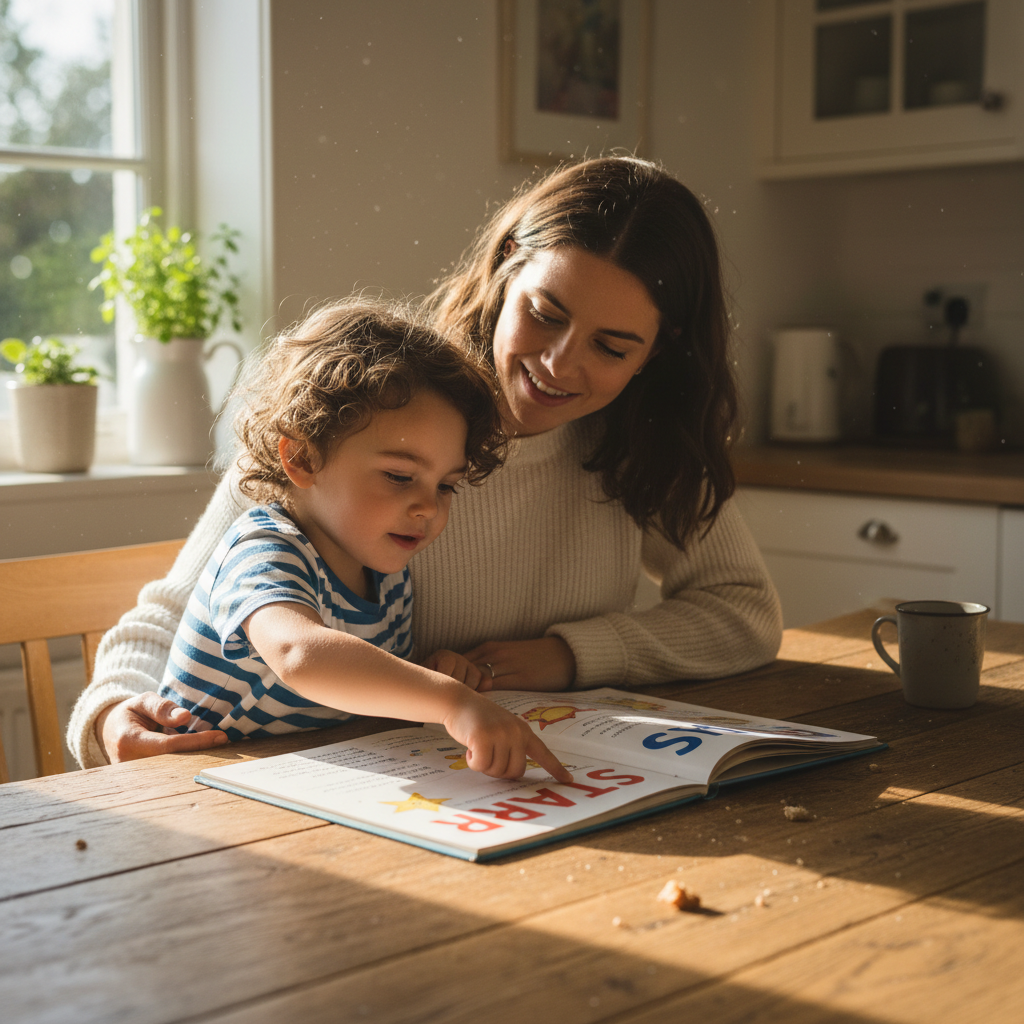
Parent and child sitting together at a kitchen table, child pointing at a word in a picture book, morning light streaming through window

Reading streak

14 days 🔥

Lesson 3 Complete

Blending short vowels

New word decoded

sun

Meet the families

Family Stories

Three families who sound like you. Three outcomes that surprised them.

Scroll through their stories. Every section is one family: the worry, the method, and the shift.

Young girl with braids sitting cross-legged on a rug, holding an open picture book, looking down at the pages with concentration

Phonics concept

Phonemic Awareness

Smiling Nigerian-American woman with warm expression, natural hair, soft indoor lighting

The Okafor Family

Atlanta, GA · Maya, 5 years old

The worry

"She was falling behind and starting to hate books."

Maya's kindergarten teacher sent home a note in October: she was still guessing at words by looking at the picture. Every reading session ended in tears — hers and mine. I Googled 'is my five-year-old behind in reading' at 11pm more times than I can count.

The method

"We did ten minutes after breakfast with Lesson Set 3."

The phonemic awareness songs in Set 3 were the turning point. Maya would tap her fingers on the table — one tap per sound. /k/ /æ/ /t/. We did it every morning while her little brother finished his cereal. No worksheets. No stress. Just the song and the taps.

The shift

"By February she was reading her baby brother bedtime stories."

I watched her sound out 'frog' on her own — a word we'd never practiced together. That was the moment I understood the difference between memorizing and decoding. She wasn't recognizing a word she'd seen before. She was reading.

Why it worked

Phonemic awareness — the ability to hear and manipulate individual sounds — is the single strongest predictor of reading success. Maya learned to isolate phonemes before she ever touched a letter.

I stopped Googling 'is my child behind' and started watching her read ahead.

Adaeze Okafor

Reading at grade level by March

Small boy with curly hair sitting at a wooden table, tongue slightly out in concentration, tracing letters in a workbook

Phonics concept

Blending

Thoughtful woman with light brown hair, wearing a linen shirt, seated by a window with natural light

The Hendersons

Portland, OR · Homeschool family · Theo, 4 years old

The worry

"I was building a morning basket and nothing was sticking."

We'd tried three different phonics programs. Theo would memorize 'the' and 'said' from flashcards and then freeze completely when he saw a new word. I wanted him to understand how reading works, not just collect words like trading cards.

The method

"The blending ladders in Lesson Sets 1 and 2 finally made it click."

The blending sequence starts with continuous sounds — /s/, /m/, /f/ — which are easier to hold than stop sounds like /b/ or /p/. Theo would stretch the first sound like taffy: "sssss-un." Within two weeks he was blending three-phoneme words without the scaffold.

The shift

"At four years old, he reads the labels on everything in our kitchen."

Cereal boxes, spice jars, the side of the milk carton. He reads them out loud, slowly, then faster. His older sister started quizzing him. Last week he read 'cinnamon' off a spice jar. He was so proud he called his grandmother to tell her.

Why it worked

Blending — pushing sounds together to form words — is a skill, not an instinct. Theo's program built it systematically, starting with the easiest phoneme types and adding complexity only when the foundation was solid.

He doesn't guess at words. He works them out, sound by sound, and then his face just lights up.

Lena Henderson

Reading independently at 4 years, 8 months

First-grade boy with dark hair at a classroom table, finger under a line of text in a reader, looking up with a surprised happy expression

Phonics concept

Segmenting

Vietnamese-American woman with glasses and a warm smile, professional setting, bookshelves visible in background

Room 12, Lincoln Elementary

San Jose, CA · Jordan, 6 years old

The worry

"Jordan sat in the back row and guessed at every word."

Jordan had learned to be invisible. He'd look at the picture, guess a word that made sense, and move on. He was smart enough to fool a casual observer. But he couldn't decode 'bat' if you covered the picture. By January of first grade, I was worried about retention.

The method

"Segmenting practice in the Phonics program finally gave him a strategy."

We used the program's segmenting exercises — breaking words apart into individual sounds — as a five-minute warm-up before independent reading. Jordan would say each sound with a finger tap on his arm. /b/ /æ/ /t/. Three taps, three sounds, one word. He had a strategy that wasn't 'guess and hope.'

The shift

"He raised his hand to read aloud for the first time in February."

That was the shift. Not a test score — a hand raised voluntarily. Jordan read a full sentence out loud to the class. He stumbled on 'splash,' worked through each phoneme, and got it. The class clapped. He looked at me like he didn't know what to do with that feeling.

Why it worked

Segmenting — breaking a spoken word into its individual phonemes — is the counterpart to blending. Together, blending and segmenting give children a complete two-way system for decoding any word they encounter.

He went from invisible to raising his hand. That's the whole job.

Ms. Tran, 1st Grade Teacher

On grade level by end of Q1 · No retention needed

How It Works

A system, not a collection of activities.

Most reading programs give you activities. Phonics gives you a sequence — the same sequence that speech-language pathologists and reading specialists use, distilled into ten-minute lessons any parent can lead.

01

Choose your child's starting point

A 3-minute placement song tells you exactly which Lesson Set to begin with — no tests, no stress.

The placement is built into a short interactive song. Your child taps along to syllables and phonemes. You'll know their starting set before the song finishes.

02

Ten minutes, every morning

Each lesson is exactly ten minutes — short enough to finish before school, long enough to build the skill.

The lessons follow a consistent structure: warm-up song → new phoneme introduction → blending practice → a short decodable story. Predictability reduces resistance.

03

Your child leads with their voice

No worksheets in the first half of each set. Your child speaks, sings, and taps — before they ever write.

Oral phonemic work must precede written phonics. This is the most commonly skipped step in at-home reading programs, and the most important one.

04

Watch the decoding click

By the end of each four-week Lesson Set, your child will decode words they've never seen before.

That's the test. Not "can they read this book" but "can they decode this new word." Generalization — reading unfamiliar words — is the proof the system is working.

40,000+

Families enrolled

10 min

Per lesson, no more

7 days

To see a shift

94%

Report a breakthrough by Week 4

Inside the Program

Six Lesson Sets. One complete reading foundation.

Each set builds on the last. You can start anywhere your child is — and know exactly where they’re headed.

Mother and young daughter on a cozy couch reading together, picture book open between them, warm afternoon light, both pointing at something on the page
Lesson Sets 1–2

Phonemic Awareness & First Sounds

Continuous sounds, rhyme, syllable clapping, and the first 12 phoneme–grapheme pairs. Ages 3–4 start here.

Lesson Set 3

Short Vowels & CVC Blending

cat, sit, hop, bug — the backbone of early decoding. Where most children have their first big breakthrough.

c
a
t
Lesson Set 4

Blends, Digraphs & Segmenting

sh, ch, th, bl, cr — plus the finger-tapping segmenting practice that turned Jordan from a guesser into a decoder.

sh
ip
Lesson Set 5

Long Vowels & Silent-E

The magic-e rule, vowel teams, and the decodable stories that made Theo read cereal boxes.

cakec·ā·ke
Lesson Set 6

Multisyllabic Words & Fluency

Breaking long words into syllables and reading with natural rhythm — the bridge to chapter books.

win · ter · time

Every set includes

  • 20 × 10-min lesson plans
  • Phoneme song recordings
  • Decodable story PDFs
  • Parent coaching notes
  • Progress tracker

Also used in classrooms

Ms. Tran runs the Lesson Set 3 warm-up with her entire first-grade class every morning. “It takes five minutes and it’s the best five minutes of our reading block. Even my strongest readers benefit from the phonemic work.”

Start Free

Seven days. No credit card. Just your kitchen table.

Your free trial includes the complete Lesson Set 1 — all 20 lessons, the phoneme songs, the decodable stories, and the parent coaching notes.

Start Your Free 7-Day Lesson Set

Three questions. Thirty seconds.

No credit card required · Unsubscribe anytime · We never share your email

What’s inside your free trial

  • 📚

    20 complete lesson plans

    Each exactly 10 minutes. Parent-led, no prep required.

  • 🎵

    All phoneme songs for Set 1

    Audio files for every lesson — your child will ask to hear them again.

  • 📖

    5 decodable story PDFs

    Print or read on screen. Only words your child can already decode.

  • 📝

    Parent coaching notes

    What to watch for, how to respond when they get stuck, what the goal of each lesson is.

📋

Get the Parent’s Phonics Roadmap

A one-page guide to exactly what your child should know at each age — and what to do if they’re behind. Free PDF, no trial required.

💛

Not sure yet?

The three families above all started by Googling “is my child behind.” If you’re here, you’re already doing the right thing. The roadmap PDF is a good first step, no commitment needed.